
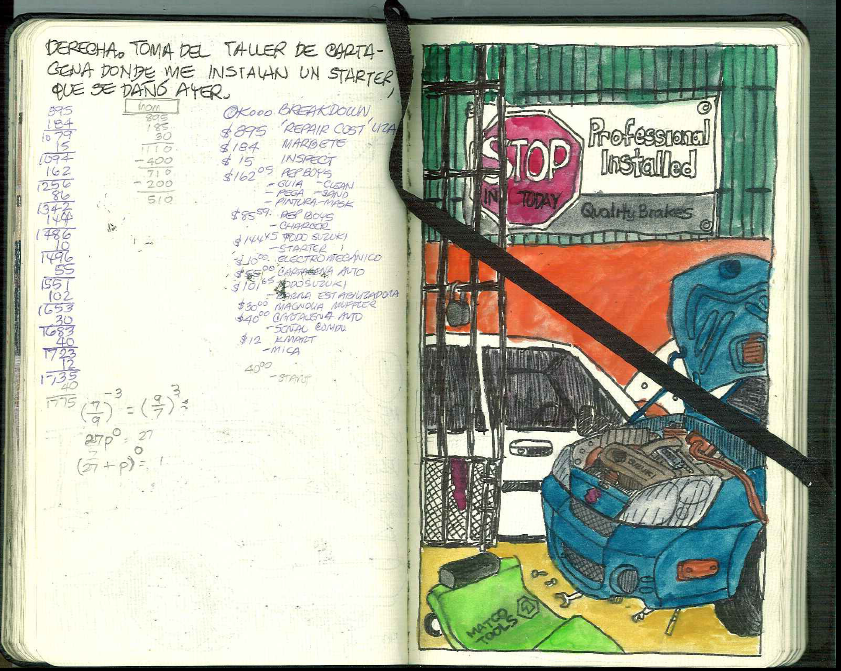
 Issue # 1 - I Got My Car Back
Tras a/no y medio de estar varado en casa se le reparo la transmision y las puntas de eje del Aerio. De vez le enderezaron par de entuertos y esta corriendo. Esta pasada semana le hicimos ajustes finales que incluyeron la eliminacion de un cortacorriente y un starter defectuoso. Una gran preocupacion resuelta, aunque todavia me queda por pagar la mitad de las cosas que se hicieron. Hice este lindo sketch mientras le instalaban el starter, luego lo pinte en casa con las acuarelas.

Issue # 2 - La AEE Me Tiene a Obscuras
Pasa Earl cerca de Puerto Rico, me llevan la luz a las 8 PM y todavia no ha vuelto. La necesito ahora mucho pues me toca viajar de nuevo a Mississippi y me acabo de enterar. Mientras tanto practicare ecolocacion (http://encyclopedia.farlex.com/echolocation), caminando como los murcielagos, a obscuras por toda la ruta en casa.
A mi no me molesta la obscuridad. Busco a tientas mi ruta. Conozco mis alrededores. A mi hijo no le agrada. Si no tiene una vela o un flashlight se hace un ocho. Este articulo habla de la ecolocacion como tecnica de nuestros antepasados...
Este articulo estaba en las cosas viejas aqui incluyo nota:
Citing Jean-Jacques Rousseau's book Émile, Ekirch suggests that echolocation was one of the best methods: a portable, sonic tool for finding your way through unfamiliar towns or buildings. And it could all be as simple as clapping.
From Émile: "You will perceive by the resonance of the place whether the area is large or small, whether you are in the middle or in a corner." You could then move about that space with a knowledge, however vague, of your surroundings, avoiding the painful edge where space gives way to object. And if you get lost, you can simply clap again. Ekirch goes on to say, however, that "a number of ingenious techniques" were developed in a pre-electrified world for finding one's way through darkness (even across natural landscapes by night). These techniques were "no doubt passed from one generation to another," he adds, implying that there might yet be assembled a catalog of vernacular techniques for navigating darkness. It would be a fascinating thing to read. Some of these techniques, beyond Rousseau and his clapping hands, were material; they included small signs and markers such as "a handmade notch in the wood railing leading to the second floor," allowing you to calculate how many steps lay ahead, as well as backing all furniture up against the walls at night to open clear paths of movement through the household. Entire, community-wide children's games were also devised so that everyone growing up in a village could become intimately familiar with the local landscape.
Games like "Round and Round the Village," popular in much of England, familiarized children at an early age to their physical surroundings, as did fishing, collecting herbs, and running errands. Schooled by adults in night's perils, children learned to negotiate the landscapes "as a rabbit knows his burrow"—careful after dark to skirt ponds, wells, and other hazardous terrain. In towns and cities, shop signs, doorways, and back alleys afforded fixed landmarks for neighborhood youths.Incredibly, Ekirch points out, "Only during the winter, in the event of a heavy snowfall, could surroundings lose their familiarity, despite the advantage to travels of a lighter, more visible landscape." The mnemonic presence of well-known community landmarks has been replaced by what mammoth calls a "whitesward." But this idea, so incredibly basic, that children's games could actually function as pedagogic tools—immersive geographic lessons—so that kids might learn how to prepare for the coming night, is an amazing one, and I have to wonder what games today might serve a similar function. Earthquake-preparedness drills?
Mas del libro Emile y de Rousseau aqui:
Los espa/noles estudian este principio en mas detalles:
"Wired reports that with just a few weeks of training, you can learn to 'see' objects in the dark using echolocation the same way dolphins and bats do. Acoustic expert Juan Antonio Martinez at the University of Alcalá de Henares in Spain has developed a system to teach people how to use echolocation, a skill that could be particularly useful for the blind and for people who work under dark or smoky conditions, like firefighters — or cat burglars. 'Two hours per day for a couple of weeks are enough to distinguish whether you have an object in front of you,' says Martinez. 'Within another couple weeks you can tell the difference between trees and pavement.' To master the art of echolocation, you can begin by making the typical 'sh' sound used to make someone be quiet. Moving a pen in front of the mouth can be noticed right away similar to the phenomenon when traveling in a car with the windows down, which makes it possible to 'hear' gaps in the verge of the road. The next level is to learn how to master 'palate clicks,' special clicks with your tongue and palate that are better than other sounds because they can be made in a uniform way, work at a lower intensity, and don't get drowned out by ambient noise. With the palate click you can learn to recognize slight changes in the way the clicks sound depending on what objects are nearby. 'For all of us in general, this would be a new way of perceiving the world,' says Martinez."
Mas sobre la ecolocacion en los ciegos aqui:
http://www.hcs.harvard.edu/~hsmbb/BRAIN/vol1/echo.html
http://www.hcs.harvard.edu/~hsmbb/BRAIN/vol1/echo.html
Several species of animals, most notably bats and dolphins, use their own emitted sounds, along with their auditory systems to perceive and localize objects in their environment. Pulses of emitted sound reflect from objects in the animal's path and may be interpreted by the auditory system, much as refl ected light waves are interpreted by the visual system (16). This ability to localize objects with echoes was termed echolocation by Donald Griffin, who, in 1938, pioneered a breakthrough in the science of auditory perception with his discovery of the ba ts' amazing ability to utilize high-frequency sounds to avoid obstacles (3). Echolocation makes it possible for species to decrease their dependence on the visual system; such independence confers advantages to the echolocator for navigation and huntin g under poor lighting conditions. Echolocation has also been observed in terrestrial mammals, such as rodents, insectivores, Megachiroptera, and in nocturnal cave-dwelling oil birds and cave swiftlets (11). In the past fifty years, research has re vealed that the auditory system is a major tool of perception employed by blind humans.
Similarities of Human and Bat EcholocationBlind and blindfolded sighted human subjects were in fact able to learn to use echolocation to detect objects in their environment (5). Efforts have been made to devise an effective mechanical aid for the blind to improve their auditory perception of obstacles (4).
From 1944 to 1947 the Committee on Sensory Devices of the National Academy of Scien ces developed eighteen different portable devices to aid the blind in avoiding obstacles. Only two performed sufficiently well, but these devices performed analysis on a point-by-point basis. This point-by-point analysis can be compared to a flashlight which "reveals only the small portion of the environment that falls within its scope (18)." Much remains to be learned about the physical properties and cues which affect object perception by the blind.
These issues were addressed by many scientists , including Diderot who, in 1749, recorded his observation that a blind person has the ability to perceive the presence and distance of objects. Since then different theories have been postulated to account for this phenomenon. One theory described obje ct detection through the use of skin sensitivity to temperature or pressure. Another theory offered pressure on the tympanic membrane (which vibrates with sound waves in the inner ear) as the mechanism of detection. Occult theories postulated object det ection through utilization of such phenomena as magnetism, electricity, or a sixth sense. The blind themselves had different interpretations of the mechanism of their perception.
From 1944 to 1947 the Committee on Sensory Devices of the National Academy of Scien ces developed eighteen different portable devices to aid the blind in avoiding obstacles. Only two performed sufficiently well, but these devices performed analysis on a point-by-point basis. This point-by-point analysis can be compared to a flashlight which "reveals only the small portion of the environment that falls within its scope (18)." Much remains to be learned about the physical properties and cues which affect object perception by the blind.
These issues were addressed by many scientists , including Diderot who, in 1749, recorded his observation that a blind person has the ability to perceive the presence and distance of objects. Since then different theories have been postulated to account for this phenomenon. One theory described obje ct detection through the use of skin sensitivity to temperature or pressure. Another theory offered pressure on the tympanic membrane (which vibrates with sound waves in the inner ear) as the mechanism of detection. Occult theories postulated object det ection through utilization of such phenomena as magnetism, electricity, or a sixth sense. The blind themselves had different interpretations of the mechanism of their perception.

Aunque no...no creo que estemos todavia en los niveles de ecolocacion de Daredevil...
Issue # 3 - Sin Titulo - No Preguntes Simplemente Leelo
Me gusto mucho este webcomic. Lo lei de una sentada...Muy buena historia y me gusto el pacing de la historia y el layout de las paginas...Esta en su mejor parte...y es ongoing.
http://www.sintitulocomic.com/2007/06/17/page-01/

Ahora salgo de la oficina a llegar a casa, a obscuras...a tientas. Cierra agosto y entra octubre.


