Una vez mas, un articulo inspirado en un comentario relacionado a las semillas de Monsanto y la guerra de las drogas, auspiciado por Monsanto. Antigonum solo me menciono el Glyphosate y su rociado en Sur America. Asi que decidi indagar en el tema, sobre todo cuando Monsanto y sus asesores buscan convencer a EPA y al congreso de relajar las restriccciones al uso del Glifosato (Round Up) en las leyes de pesticidas (FIFRA, para el que le interese).
Hace bastante tiempo atrás habia hablado de este problema de escala mundial. Pero desde el punto de vista de las semillas. En este round (no pun intended) Monsanto tiene otro lio, relacionado al uso de su popular pesticida Round Up y Glyphosate, su ingrediente activo. Mi articulo original aquí:
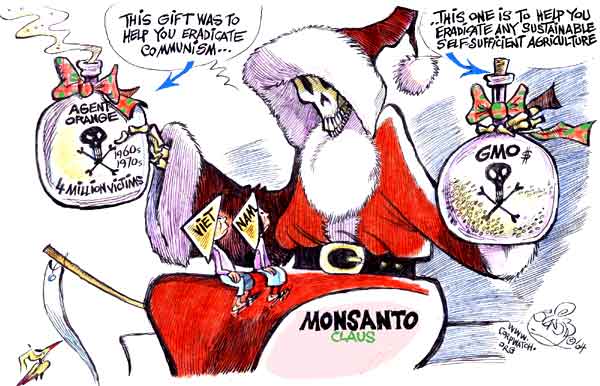
Antigonum, usted es la changa. Hablando de lo de Monsanto se habla de reducir el riesgo de pesticida del Glyphosate (Roundup). El instinto de sobrevivencia establece que siempre existe la posibilidad de haber una cepa resistente a cualquier cosa. Pasa con las bacterias, pasa con los humanos y animales. Era cuestión de tiempo y algo de justicia poética que Monsanto y su grupo de geniales científicos descubriesen que ya hay sobre 20 especies de yerbajos que tienen resistencia al Roundup. Es la evolución. La especie mas apta sobrevive, la cepa que no tiene capacidad desaparece. Aquí les dejo esta información que viene de Maggie Koerth Baker, una de las consejeras científicas de Boing Boing.
Whatever its faults, the seed company Monsanto does employ some very smart people, who have a keen understanding of plant genetics. Given that, I've long wondered why the company has been so blindsided by the fairly basic idea that weeds evolve. Did anyone really expect that, when faced with a pressure that threatened their existence, the weeds wouldn't adapt and become resistant to Monsanto's Roundup herbicide?
Why didn't people there think resistance would happen? They all told a similar story.
First, the company had been selling Roundup for years without any problems. Second, and perhaps most important, the company's scientists had just spent more than a decade, and many millions of dollars, trying to create the Roundup-resistant plants that they desperately wanted — soybeans and cotton and corn. It had been incredibly difficult. When I interviewed former Monsanto scientists for my book on biotech crops, one of them called it the company's "Manhattan
Considering how hard it had been to create those crops, "the thinking was, it would be really difficult for weeds to become tolerant" to Roundup, says Rick Cole, who is now responsible for Monsanto's efforts to deal with the problem of resistant weeds. Cole went to work at Monsanto in 1996, the same year that the first Roundup Ready crops went on the market.
So how did the company's experts react when weeds began to prove them wrong? "The reaction was, 'What is really going on here?' " says Cole. Monsanto began a "massive effort" to figure out how the weeds withstand glyphosate. Some weeds, Cole says, appear to keep glyphosate from entering the plant at all; others sequester the herbicide in a spot where it can't do much damage. Monsanto's genetically engineered crops use a different technique entirely.
Recursos:
Relacionados a articulos exponiendo toxicidad y especies resistentes al Glyphosate.

Interesante perspectiva. Uso de Herbicidas para exterminar la coca hace que crezcan cepas resistentes al quimico. La guerra de Monsanto viaja al sur…
Over the past three years, rumors of a new strain of coca have circulated in the Colombian military. The new plant, samples of which are spread out on this table, goes by different names: supercoca, la millonaria. Here in the southern region it's known as Boliviana negra. The most impressive characteristic is not that it produces more leaves - though it does - but that it is resistant to glyphosate. The herbicide, known by its brand name, Roundup, is the key ingredient in the US-financed, billion-dollar aerial coca fumigation campaign that is a cornerstone of America
One possible explanation: The farmers of the region may have used selective breeding to develop a hardier strain of coca. If a plant happened to demonstrate herbicide resistance, it would be more widely cultivated, and clippings would be either sold or, in many cases, given away or even stolen by other farmers. Such a peer-to-peer network could, over time, result in a coca crop that can withstand large-scale aerial spraying campaigns.
But experts in herbicide resistance suspect that there is another, more intriguing possibility: The coca plant may have been genetically modified in a lab. The technology is fairly trivial. In 1996, Monsanto commercialized its patented Roundup Ready soybean - a genetically modified plant impervious to glyphosate. The innovation ushered in an era of hyperefficient soybean production: Farmers were able to spray entire fields, killing all the weeds and leaving behind a thriving soybean crop. The arrival of Roundup Ready coca would have a similar effect - except that in this case, it would be the US
Whether its resistance came from selective breeding or genetic modification, the new strain poses a significant foreign-policy challenge to the US Washington Colombia
Mas detalles de la guerra de las drogas fallida de los US…
For a number of years the U.S. has sponsored herbicide spraying in Colombia U.S.
Representatives of Colombian indigenous communities recently traveled to Washington , D.C.
According to the NEW YORK TIMES, in one case several spray victims traveled 55 miles by bus to visit a hospital. The doctor who treated them said their symptoms included dizziness, nausea, muscle and joint pain, and skin rashes. "We do not have the scientific means here to prove they suffered pesticide poisoning, but the symptoms they displayed were certainly consistent with that condition," he said. A nurse's aide in the local clinic said she had been instructed "not to talk to anyone about what happened here."[4]
The U.S. U.S. embassy official in Colombia Colombia
we
But the resulting article is perhaps most interesting for the taciturn response on all sides of the issue. Davis suggests that South American authorities don't want to talk about the situation because the revelation might cost countries that receive a large amount of U.S. U.S. U.S.
But on the larger cost-benefit analysis, the biggest winner is Monsanto. The more Roundup Ready crops there are out there, the more Roundup farmers need to get rid of the weeds, as is evidenced by the GRAIN research in Argentina
When you put together the studies referenced above, which show that spraying glyphosate is harmful to humans and the environment and that it does not hamper the production of coca or weeds, the answer to almost everyone's problems is eliminating Monsanto.
So while there's no solid proof that the men threatening Andrés Carrasco belong to the same corporation that falsified lab results on the harm caused by glyphosate or the group that told lies about Roundup, there's no doubt in my mind that they belong in the same sick club.
Images: