Showing posts with label dibujos. Show all posts

Tuesday, January 11, 2011

Twilight Zone Boricua 01

Decidi comenzar el 2011 con algo para variar la monotonia.  Hice esta peque/na historia tipo Twilight Zone inspirado en las fincas de criollos y como toda buena idea puede ser convertido en un regimen totalitario.  Comence con este tema puesto que el tema del estadista criollo que encuentra que los anglos son unos canallas para los que no son suyos es un tema trillado en Puerto Rico.

Luego revisito el tema.   Hay muchos otros temas que presentar.


Sunday, November 14, 2010

Backtrip en 1996 - Estudios de Tinte en Rios de Puerto Rico

En temas relacionados a contaminacion de agua recordaba mis dias de tecnico de permisos para la Junta de Calidad Ambiental en Hato Rey. En aquella era se nos habia encomendado determinar la capacidad asimilativa de varios cuerpos de agua de Puerto Rico. O sea, para aquellas facilidades que descargan a rios de la isla qu cantidad de materia organica era la maxima que podia descargarse sin que se bajase de un nivel de 5 mg/l de oxigeno disuelto en el rio.

Lo que se nos indicaba era que habia que caminar el rio y modelarlo matematicamente. En buen castellano, caminar un tramo de sobre 1 km de rio, determinar la condicion del rio, su flujo y compararlo con el flujo bajo teorico de los libros (ese es otro tema) y determinar el ancho y la profundidad promedio del segmento.
Asi que comenzamos a hacer estudios por toda la isla con grupos de 10 - 15 personas midiendo, caminando, buscando accesos, enfrentando vacas, ara/nas y otros obstaculos.
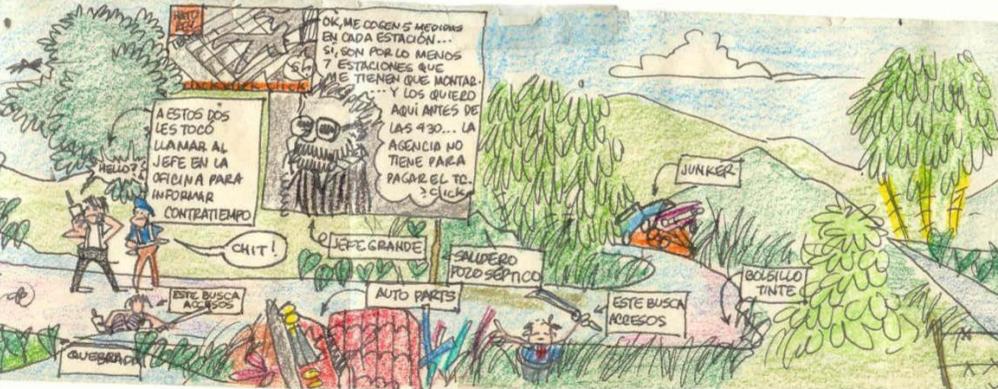
En ese momento hice una caricatura de estos estudios en una cinta de maquina de sumar. Creo que mide unos 6 a 7 pies de largo...La primera imagen presenta el principio de la caricatura, el punto de descarga de cierta planta de tratamiento de aguas usadas. Es ficticio, la planta de Matusalen, en el barrio Las Sinforas de Mayaguez (By the way Kofla, se que no hay un barrio Sinforas en Mayaguez...).
Este segundo segmento es como a una cuarta parte del dibujo. era 1996 asi que ni internet, ni DSL, y los celulares corrian en redes analogas. Aqui el supervisor del site consulta con el gran jefe en la oficina de Hato Rey, que sugiere unas breves instrucciones...
Rios de vertederos, vacas cruzando el rio, puntos de droga...todo esto lo vimos en estos rios. Pero fue una buena experiencia que en mi caso duro unos dos a/nos (ahi me fui a otros menesteres). Solo para muestra un boton, este es una foto cuando median uno de los segmentos de rio. Yo era el de la camara, era el que vigilaba el tinte en el medio kilometro y despues era el que entraba la data de campo y las medidas de flujo en la computadora. En esa misma foto, la primera muchacha tiene un odometro para marcar cada 50 metros (eran como 65 estaciones a lo largo del rio), dos miden el ancho y la otra persona tomaba entre 5 a 8 profunidades equidistantes del tramo.
Por si acaso, el manchon que esta debajo es el dibujo original...Es bien ancho.
Por aquello de que a algun ser humano le interese esta es una explicacion de lo que dije dado por los amigos del DEQ de Louisiana (http://www.deq.louisiana.gov/portal/DIVISIONS/WaterQualityAssessment/TotalMaximumDailyLoadTMDLProgram/TimeofTravelStudies.aspx)

Otros usos de estos estudios son para simular derrames de aceites o quimicos:
http://www.uswaternews.com/archives/arcquality/9newtim11.html

Y mi antigua alma mater:
http://www.gobierno.pr/jca/inicio
http://books.google.com/books?id=tHlCGyOoK1oC&pg=PA121&lpg=PA121&dq=fluorescent+dye+studies+waterbodies&source=bl&ots=S_tWKesQuy&sig=00BrQpsg69zChTsxo1ZtnPgw_zk&hl=en&ei=LXPgTJObNIWKlweS09TQAw&sa=X&oi=book_result&ct=result&resnum=1&ved=0CBoQ6AEwAA#v=onepage&q&f=false
http://www.google.com/images?q=fluorescent+dye+studies+waterbodies&oe=utf-8&rls=org.mozilla:en-US:official&client=firefox-a&um=1&ie=UTF-8&source=og&sa=N&hl=en&tab=wi&biw=800&bih=332

En realidad lo que se hace en el rio no era lo importante, solo era mostrar lo que alguien con tiempo de ocio podia hacer entre actividades de field.

Friday, October 1, 2010

Reflexiones Sobre La Violencia Policiaca


Un nuveo ciclo de violencia comienza, con varios casos donde la Policia de Puerto Rico dispara primero y pregunta despues. A mi personalmente me han impactado de sobremanera el asesinato del joven en Altamira, que hizo lo que dice el anuncio, de ayudar al Policia como deber civico. Mas aun el asesinato del anciano a manos de unos policias que iban a allanar su casa.


Aunque no soy de ver television estos dias estas noticias resuenan en mi ser, tratando de buscarle un sentido. Pudiesemos ser llanos, y solo decir que es un asunto centralizado en la Policia, pero la realidad es otra. Hay violencia de todo tipo. Unos contra otros, por cualquier estupidez, sea esta religiosa, de clases sociales, de ideologias politicas o de lo que sea.


Valoramos tan poco la vida.


Asi que hice un boceto en lapiz de lo que paso con el anciano en la oscuridad de la noche, mienras iba en el tren pasadas las 8 de la noche. Era un boceto malisimo pero trabajo en una idea. Mientras el anciano iba temiendo por su vida estos policias trigger happy pensaban que era un juego de video. No es la primera vez que esto ocurre. En la pasada huelga los mensajes de los policias hablaban de tumbar cabezas y cobrar cuentas viejas. Me tumbaste la pajita del hombro, ahora te tumbo la cabeza a macanazos.


Necesitamos cambiar de actitudes. No creo que nuestro superintendente sea el mejor ejemplo de tolerancia y respeto. Nos gusta el jaqueton y el sinverguenza. Somos del reino donde nuestras referencias noticiosas vienen de La Comay.


Por aquello de ayudar a nuestros amigos extranjeros, algunos articulos relacionados al asesinato:

http://www.vocero.com/noticias/ley-y-orden/14444.html

http://www.vocero.com/noticias/44-ultimas-noticias/14357-policia-mata-individuo.html

http://www.elnuevodia.com/policiasmatanaancianoqueintentoevitarallanamientoensucasa-788903.html


Comienzo dando unos links al asunto de la violencia y sus origenes. Este articulo de Forbes da una idea. Si nos desensibilizamos al dolor ajeno, si mo somos empaticos, cometeremos atrocidades:

http://www.forbes.com/2010/06/15/forbes-india-david-livingstone-smith-psychology-of-violence-opinions-ideas-10-smith.html


For example, one veteran confessed that, because a woman's crying infant was interfering with his rape of her he "took a living human child … an innocent baby that was just beginning to talk, and threw it into boiling water." It is hard to imagine normal men behaving in this way. Try to imagine yourself doing it, and your mind will probably recoil in disgust. However, the soldiers who committed these atrocities were neither madmen nor monsters. They were, for the most part, ordinary people. People like you. The same is true of all the other mass atrocities that litter human history. The infernal ovens of Auschwitz, the mass graves at Srebrenica and the killing fields of Pol Pot's Kampuchea were all the handiwork of ordinary people

These observations raise an extremely important question. What goes on in the human mind to make such brutality possible? Yoshio Tshuchiya, another Japanese veteran interviewed in Katsuichi's book, gestures towards an answer. "We called the Chinese ‘chancorro' … that meant below human, like bugs or animals … The Chinese didn't belong to the human race. That was the way we looked at it." "If I'd thought of them as human beings I couldn't have done it," he observed, "But … I thought of them as animals or below human beings."


This is called dehumanization. We dehumanize our fellow human beings when we convince ourselves (or allow ourselves to be convinced) that they are less than human and come to believe that, although these people appear to be human beings like us, this is merely a façade. Beneath the surface they are really subhuman creatures, fit to be hunted down and destroyed. The immense destructive power of dehumanization lies in the fact that it excludes its victims from the universe of moral obligation, so killing them is of no greater consequence swatting a mosquito, or poisoning a rat. If dehumanization is a key factor in war and genocide, we ought to be working very hard to prevent it.

Otros culpan al televisor y a los videojuegos.


Personalmente lo achaco a nuestra falta de valores. Si estoy rodeado de personas que hacen trampas, son corruptos, se roban el cable TV, la luz y el agua, o que son Pay Per Play, como algunos funcionarios politicos...nos sorprende entonces que nuestros funcionarios y policias sean manzanas podridas?


Yo sigo leyendo libros que traje de alla. Luego escribo algo relacionado.
Cierro con una historia zen. El Aguila que Creia Ser Gallina


A man found an eagle's egg and put it in a nest of a barnyard hen. The eaglet hatched with the brood of chicks and grew up with them.
All his life the eagle did what the barnyard chicks did, thinking he was a barnyard chicken. He scratched the earth for worms and insects. He clucked and cackled. And he would thrash his wings and fly a few feet into the air.
Years passed and the eagle grew very old. One day he saw a magnificent bird above him in the cloudless sky. It glided in graceful majesty among the powerful wind currents, with scarcely a beat of its strong golden wings.
The old eagle looked up in awe. "Who's that?" he asked.
"That's the eagle, the king of the birds," said his neighbor. "He belongs to the sky. We belong to the earth-- we're chickens." So the eagle lived and died a chicken, for that's what he thought he was.
From Awareness: The Perils and Opportunities of Reality
by Anthony de Mello

Friday, September 10, 2010

Jugando con las Acuarelas

Solo deseaba usar este post para poner algunos bocetos que he hecho en mi moleskin. Hacia a/nos que no usaba las acuarelas y les estoy cogiendo el gusto. Mis ultimos dibujos siempre usaban flares negros.

Por ejemplo, la imagen 1 es un sketch de un conductor esperando turno. Sketch en lapiz. Acuarela, entonces boligrafo. Buscando composicion y movimiento en el dibujo. Que se viera natural, no forzado.


Imagen 2
Atardeciendo en Biloxi. Jugando con la composicion y el color. Tambien haciendo el boceto inicial en lapiz en un tiempo bien corto. Esta toma fue desde el tope de un tanque mientras caia la tarde. Queria poner los muchos colores, y en blanco y negro es dificil de lograr.


Imagen 3:
Planta concretera abandonada. Jugando con colores y proporcion con un sketch rapido en lapiz que hice esperando que llenaran un tanque con agua.

El boligrafo y el color se hicieron despues, entre tarea y tarea.

Sunday, September 5, 2010

Notas del Exilio 3 - Sketches de Biloxi


Como hemos estado de hiato forzado operacionalmente hemos tenido que sentarnos en el medio de la nada para esperar que las cosas ocurran. No hay electricidad, apenas hay mesa, asi que buscate una sombrita, activa el celular y esperar que las cosas ocurran.


Entre medio que hacer para no darle craneo a las cosas. Sketchear como demente. Estas dos paginas fueron entre cosa y cosa en el site...
La primera es un sketch basado en una foto de referencia de mi esposa, el nene y yo bajando el tren en la Roosevelt. Las otras son imagenes de diferentes puntos curiosos.
Es para hacer un make up por la atroz historia que presente en mi nota anterior...
Ahora si. A comer algo y luego a dormir...


Notas del Exilio 2 - Jack Gaturro

Este articulo lo escribo desde Biloxi MS. Aun estoy manejando la muerte de mi suegro Angel y me distraigo como sea para no pensar en el tema. Como todo el resto de mi familia fue muy querido y ayudo a muchas personas durante su vida. Como distraerme estando sobre 12 horas viajando entre destinos. Me dio el arrebato de seguir este comic que improvice con la pagina 1 que garabatee en el tren entre Roosevelt y Bayamon hace varios dias atras. No hacia sentido pero hice ad lib, a ver que salia. Pues...salio Jack Gaturro. Un guerrero especialista muy particular, buscando controlar las pasiones desenfrenadas de unos 'cats among us'. Lo pare en la pagina 5,por razones obvias. Esa pagina fue en el vuelo de Dallas - Gulfport. Sin mas preambulos las paginas (perdonen, en el exilio no tengo scanner todavia).


UPDATE: Reescanee imagenes. Cuento sigue igual de malo...

Tuesday, August 31, 2010

Con Carro, a Obscuras y Sin Titulo

Decidi discutir tres temas en el articulo de hoy, Primero un poquito mas de detalle del retorno del aerio. El caculo azul esta de vuelta. Seguido del tema de la obscuridad, la ecolocacion y un webcomic de lo mas interesante llamado Sin Titulo. Siin nada mas los temas.
Issue # 1 - I Got My Car Back

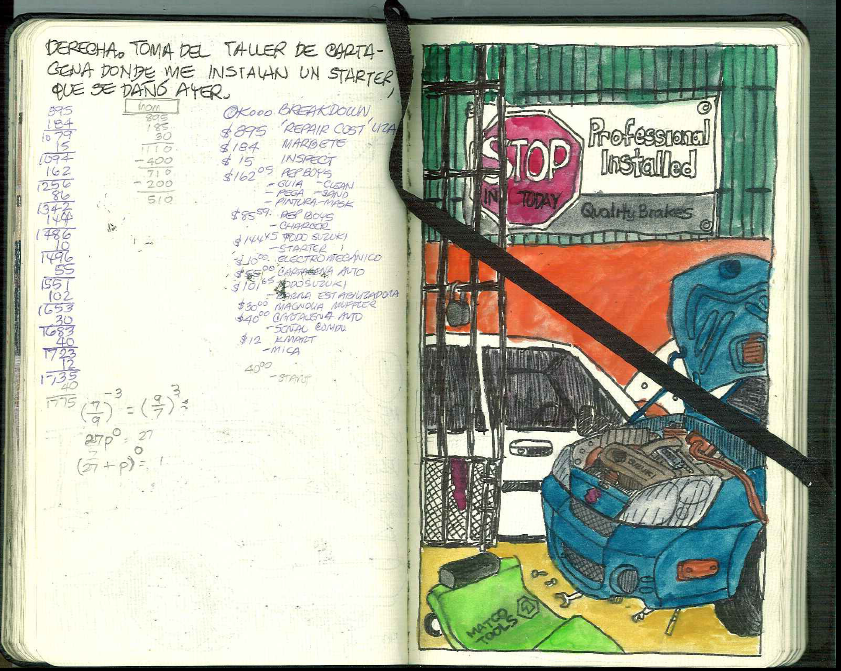
Tras a/no y medio de estar varado en casa se le reparo la transmision y las puntas de eje del Aerio. De vez le enderezaron par de entuertos y esta corriendo. Esta pasada semana le hicimos ajustes finales que incluyeron la eliminacion de un cortacorriente y un starter defectuoso. Una gran preocupacion resuelta, aunque todavia me queda por pagar la mitad de las cosas que se hicieron. Hice este lindo sketch mientras le instalaban el starter, luego lo pinte en casa con las acuarelas.


Issue # 2 - La AEE Me Tiene a Obscuras

Pasa Earl cerca de Puerto Rico, me llevan la luz a las 8 PM y todavia no ha vuelto. La necesito ahora mucho pues me toca viajar de nuevo a Mississippi y me acabo de enterar. Mientras tanto practicare ecolocacion (http://encyclopedia.farlex.com/echolocation), caminando como los murcielagos, a obscuras por toda la ruta en casa.

A mi no me molesta la obscuridad. Busco a tientas mi ruta. Conozco mis alrededores. A mi hijo no le agrada. Si no tiene una vela o un flashlight se hace un ocho. Este articulo habla de la ecolocacion como tecnica de nuestros antepasados...

Este articulo estaba en las cosas viejas aqui incluyo nota:


Citing Jean-Jacques Rousseau's book Émile, Ekirch suggests that echolocation was one of the best methods: a portable, sonic tool for finding your way through unfamiliar towns or buildings. And it could all be as simple as clapping.


From Émile: "You will perceive by the resonance of the place whether the area is large or small, whether you are in the middle or in a corner." You could then move about that space with a knowledge, however vague, of your surroundings, avoiding the painful edge where space gives way to object. And if you get lost, you can simply clap again. Ekirch goes on to say, however, that "a number of ingenious techniques" were developed in a pre-electrified world for finding one's way through darkness (even across natural landscapes by night). These techniques were "no doubt passed from one generation to another," he adds, implying that there might yet be assembled a catalog of vernacular techniques for navigating darkness. It would be a fascinating thing to read. Some of these techniques, beyond Rousseau and his clapping hands, were material; they included small signs and markers such as "a handmade notch in the wood railing leading to the second floor," allowing you to calculate how many steps lay ahead, as well as backing all furniture up against the walls at night to open clear paths of movement through the household. Entire, community-wide children's games were also devised so that everyone growing up in a village could become intimately familiar with the local landscape.

Games like "Round and Round the Village," popular in much of England, familiarized children at an early age to their physical surroundings, as did fishing, collecting herbs, and running errands. Schooled by adults in night's perils, children learned to negotiate the landscapes "as a rabbit knows his burrow"—careful after dark to skirt ponds, wells, and other hazardous terrain. In towns and cities, shop signs, doorways, and back alleys afforded fixed landmarks for neighborhood youths.Incredibly, Ekirch points out, "Only during the winter, in the event of a heavy snowfall, could surroundings lose their familiarity, despite the advantage to travels of a lighter, more visible landscape." The mnemonic presence of well-known community landmarks has been replaced by what mammoth calls a "whitesward." But this idea, so incredibly basic, that children's games could actually function as pedagogic tools—immersive geographic lessons—so that kids might learn how to prepare for the coming night, is an amazing one, and I have to wonder what games today might serve a similar function. Earthquake-preparedness drills?

Mas del libro Emile y de Rousseau aqui:


Los espa/noles estudian este principio en mas detalles:


"Wired reports that with just a few weeks of training, you can learn to 'see' objects in the dark using echolocation the same way dolphins and bats do. Acoustic expert Juan Antonio Martinez at the University of Alcalá de Henares in Spain has developed a system to teach people how to use echolocation, a skill that could be particularly useful for the blind and for people who work under dark or smoky conditions, like firefighters — or cat burglars. 'Two hours per day for a couple of weeks are enough to distinguish whether you have an object in front of you,' says Martinez. 'Within another couple weeks you can tell the difference between trees and pavement.' To master the art of echolocation, you can begin by making the typical 'sh' sound used to make someone be quiet. Moving a pen in front of the mouth can be noticed right away similar to the phenomenon when traveling in a car with the windows down, which makes it possible to 'hear' gaps in the verge of the road. The next level is to learn how to master 'palate clicks,' special clicks with your tongue and palate that are better than other sounds because they can be made in a uniform way, work at a lower intensity, and don't get drowned out by ambient noise. With the palate click you can learn to recognize slight changes in the way the clicks sound depending on what objects are nearby. 'For all of us in general, this would be a new way of perceiving the world,' says Martinez."

Mas sobre la ecolocacion en los ciegos aqui:
http://www.hcs.harvard.edu/~hsmbb/BRAIN/vol1/echo.html

Several species of animals, most notably bats and dolphins, use their own emitted sounds, along with their auditory systems to perceive and localize objects in their environment. Pulses of emitted sound reflect from objects in the animal's path and may be interpreted by the auditory system, much as refl ected light waves are interpreted by the visual system (16). This ability to localize objects with echoes was termed echolocation by Donald Griffin, who, in 1938, pioneered a breakthrough in the science of auditory perception with his discovery of the ba ts' amazing ability to utilize high-frequency sounds to avoid obstacles (3). Echolocation makes it possible for species to decrease their dependence on the visual system; such independence confers advantages to the echolocator for navigation and huntin g under poor lighting conditions. Echolocation has also been observed in terrestrial mammals, such as rodents, insectivores, Megachiroptera, and in nocturnal cave-dwelling oil birds and cave swiftlets (11). In the past fifty years, research has re vealed that the auditory system is a major tool of perception employed by blind humans.


Similarities of Human and Bat EcholocationBlind and blindfolded sighted human subjects were in fact able to learn to use echolocation to detect objects in their environment (5). Efforts have been made to devise an effective mechanical aid for the blind to improve their auditory perception of obstacles (4).
From 1944 to 1947 the Committee on Sensory Devices of the National Academy of Scien ces developed eighteen different portable devices to aid the blind in avoiding obstacles. Only two performed sufficiently well, but these devices performed analysis on a point-by-point basis. This point-by-point analysis can be compared to a flashlight which "reveals only the small portion of the environment that falls within its scope (18)." Much remains to be learned about the physical properties and cues which affect object perception by the blind.
These issues were addressed by many scientists , including Diderot who, in 1749, recorded his observation that a blind person has the ability to perceive the presence and distance of objects. Since then different theories have been postulated to account for this phenomenon. One theory described obje ct detection through the use of skin sensitivity to temperature or pressure. Another theory offered pressure on the tympanic membrane (which vibrates with sound waves in the inner ear) as the mechanism of detection. Occult theories postulated object det ection through utilization of such phenomena as magnetism, electricity, or a sixth sense. The blind themselves had different interpretations of the mechanism of their perception.


Aunque no...no creo que estemos todavia en los niveles de ecolocacion de Daredevil...
Issue # 3 - Sin Titulo - No Preguntes Simplemente Leelo


Me gusto mucho este webcomic. Lo lei de una sentada...Muy buena historia y me gusto el pacing de la historia y el layout de las paginas...Esta en su mejor parte...y es ongoing.
http://www.sintitulocomic.com/2007/06/17/page-01/


Ahora salgo de la oficina a llegar a casa, a obscuras...a tientas. Cierra agosto y entra octubre.

Thursday, August 19, 2010

Dibujos Recientes desde Milla de Oro

Estos son varios dibujos de mi moleskin hechos durante la pasada semana. Andar en tren y guagua ha sido fuerza motriz de esta accion. El primero (disculpen la baja resolucion) es una prueba en acuarelas usando como referencia las mesas de Island Bagels en Hato Rey, que tiene mesas hechas en losetas de colores como en el dibujo.
Este es la vista desde el Metrobus II las otras ma/nanas.
Esta toma es desde el Coffee Express de la Ponce de Leon (colinda con el Popular Center).


Este ultimo es una prueba de acuarelas que hice en casa de un sketch malo que hice desde el edificio de la Asociacion de Industriales.

La dejo ahi.


Related Posts Plugin for WordPress, Blogger...