Showing posts with label pelicula. Show all posts

Friday, January 13, 2012

[231] Judas Iscariote, Lady Gaga y la Era de Horus

Hacia tiempo que no le ponia mi esfuerzo a la parte Alquimica de la Alcantarilla.  Asi que usando de pie forzado un articulo de Puertorriquenhadas en Mostaza sobre el personaje de Judas Iscariote decidi desarrollar un poco toda esta mitologia que esta detras.

Asi que comencemos con el 'due credit' a Antigonum y el escrito por Daniel Samper Pizano (http://es.wikipedia.org/wiki/Daniel_Samper_Pizano), 'Piedad con este pobre huerfano!", Plaza & Janes , Bogota 1984:

http://puertorikenhadasinmostaza.blogspot.com/2012/01/ante-la-ola-criminal-islenha-un-refrito.html

http://endemismotrasnochado.blogspot.com/2008/03/defensa-minima-de-judas.html
http://endemismotrasnochado.blogspot.com/2008/03/defensa-minima-de-judas-continuacion.html

Primero algo de Daniel Samper Pizano.  Escribe para la revista El Carrusel y se pueden ver sus articulos previos aqui:
http://www.eltiempo.com/noticias/daniel-samper-pizano

Judas Iscariote ha sido siempre representado como el traidor por excelencia.  Sin embargo esa percepcion ha ido alterando en literatura reciente.  Les dejo una cadena, asi como la que discuti en articulos anteriores de la historia selectiva de la Iglesia en este tema:
http://alcantarillaalquimica.blogspot.com/2011/05/179-rant-sobre-la-disidencia.html
http://alcantarillaalquimica.blogspot.com/2011/07/190-nestorianismo-historia-relegada-al.html
 
Jorge Luis Borges - Las Tres Versiones de Judas
http://en.wikipedia.org/wiki/Three_Versions_of_Judas

El cuento corto aqui:
http://www.literatura.us/borges/tres.html

Borges parece haber predicho todo lo del evangelio no canonico de Judas, el cierre aqui:
...
 En vano propusieron esa revelación las librerías de Estocolmo y de Lund. Los incrédulos la consideraron, a priori, un insípido y laborioso juego teológico; los teólogos la desdeñaron. Runeberg intuyó en esa indiferencia ecuménica una casi milagrosa confirmación. Dios ordenaba esa indiferencia; Dios no quería que se propalara en la tierra Su terrible secreto. Runeberg comprendió que no era llegada la hora: Sintió que estaban convergiendo sobre él antiguas maldiciones divinas; recordó a Elías y a Moisés, ,que en la montaña se taparon la cara para no ver a Dios; a Isaías, que se aterró cuando sus ojos vieron a Aquel cuya gloria llena la tierra; a Saúl, cuyos ojos quedaron ciegos en el camino de Damasco; al rabino Simeón ben Azaí, que vio el Paraíso y murió; al famoso hechicero Juan de Viterbo, que enloqueció cuando pudo ver a la Trinidad; a los Midrashim, que abominan de los impíos que pronuncian el Shem Hamephorash, el Secreto Nombre de Dios. ¿No era él, acaso, culpable de ese crimen oscuro? ¿No sería ésa la blasfemia contra el Espíritu, la que no será perdonada (Mateo 12: 31)? Valerio Sorano murió por haber divulgado el oculto nombre de Roma; ¿qué infinito castigo sería el suyo, por haber descubierto y divulgado el horrible nombre de Dios?
         

 Ebrio de insomnio y de vertiginosa dialéctica, Nils Runeberg erró por las calles de Malmö, rogando a voces que le fuera deparada la gracia de compartir con el Redentor el Infierno.
         

Murió de la rotura de un aneurisma, el primero de marzo de 1912. Los heresiólogos tal vez lo recordarán; agregó al concepto del Hijo, que parecía agotado, las complejidades del mal y del infortunio.1944

Judas como el heroe tras bastidores
http://en.wikipedia.org/wiki/Judas_Iscariot

  • In Martin Scorsese's film The Last Temptation of Christ, based on the novel by Nikos Kazantzakis, Judas Iscariot's only motivation in betraying Jesus to the Romans was to help him, making Judas the catalyst for the event later interpreted as bringing about humanity's salvation. This view of Judas Iscariot is reflected in the recently discovered Gospel of Judas. The film King of Kings presents a similar betrayal.


  • In Andrew Lloyd Webber's musical Jesus Christ Superstar, Judas is portrayed as a tragic hero who believed that Jesus was not the son of God, but rather just a man. Since he feared that if Jesus' following grew too large then the Romans would attack and kill the Jews, he betrayed Jesus to Caiaphas and Annas to prevent a bloodbath.


  • Si aun no han visto la pelicula, se la recomiendo.  Es excelente, sobre todo la pista por Peter Gabriel y los grandes vestuarios, incluyendo tatuajes henna para darle realismo a los actores.  Rese/nas aqui:
    http://oldschoolreviews.com/rev_80/last_temptation.htm
    One of the most outstanding aspects of Last Temptation is the incredible score composed by Peter Gabriel. It combines indigenous music from the Middle East and North Africa with folk music and some rock sounds, often with a driving "primitive" drum beat to create a unique, ethereal sound. Even if you have reservations about seeing the movie, check out the soundtrack. It may be listed under New Age music in some stores.

    Although I can understand why some Christians may have difficulty with some of the images of Christ, The Last Temptation of Christ is hardly blasphemous in spirit. The main forces behind its creation come from an eclectic Christian background--Scorsese is Roman Catholic, screenwriter Paul Schrader is Dutch Calvinist, and novelist Nikos Kazantzakis is Greek Orthodox--and they have blended their backgrounds to make a film geared towards western audiences.

    http://lasttemptationofchrist.weebly.com/judas-iscariot.html

    First of all, Judas in this canon is certainly not the Judas of the New Testament. He is not depicted as evil or a traitor. Judas was merely acting under orders because he was the strongest disciple (see "Before its Time?" above). Judas was a religious zealot who, at first was sent to kill Jesus. He accepted his teachings instead and somewhat reluctantly became a follower. At first he was disgusted by Jesus making crosses for those who oppress them. Although he began to trust Jesus and see him as the son of God. Judas seemed to understand Jesus the most and was by far the most commited disciple to the cause. With a tendency to fight more than love, Jesus and he contrasted each other.

    What made Judas's character so controversial was that some viewers considered him more wise and brave than Jesus. He is considered a stronger character to some because he confronts Jesus after Christ is shown as an old man, not having died for the sins of the Jews (see "Temptation of Jesus"). Judas has done his part, although Christ wavered and did not die as planned by God. Although this did not eventually happen, it is an intriguing point referring the character of Judas himself.

    http://www.decentfilms.com/articles/lasttemptation.html
    Un disclaimer: el autor de esta rese/na no le gusto para nada el caracter 'blasfemo' de la pelicula.  Pero da una idea de lo polarizante que es la pelicula.

    Judas the hero; John the Pentecostal

    Nor is it only the portrayal of Jesus himself that is antithetical to Christian thought. Virtually every characterization, every aspect of the film is deliberately iconoclastic, self-consciously contrary to traditional Christian understanding, calculated for shock value. First and foremost is the reinterpretation of Judas Iscariot (Harvey Keitel) as a principled hero, a man who ultimately "betrays" Jesus only because Jesus orders him to do so over Judas’ own tortured objections. When faithful Judas demands to know whether if Jesus himself, were he in Judas’ place, would be able to betray a beloved master, Jesus replies (in a moment typical of the film’s sensibilities), "No, I couldn’t. That’s why God gave me the easier job [i.e., dying on the cross]."
    Throughout the movie Judas acts almost as Jesus’ conscience. As the film opens we find Judas patriotically upbraiding Jesus for collaborating with Rome by his cross-making. When Jesus begins his ministry, Judas follows him conditionally, warning him that if he betrays his mission Judas will kill him. Finally, in the climactic scene, it is a stern, prophetic Judas (or a dream-representation of him) that recalls Jesus to the necessity of his dying on the cross.
    Once again, there’s nothing wrong with trying to humanize Judas to an extent, or give him understandable motivations. The filmmaker can even make us empathize with him to the point of feeling that we too would be capable of doing what he did. But what he did, in the end, has to be wrong; and Keitel’s Judas never manifests anything like corruption, self-interest, or pettiness. Jesus is the main character and protagonist here, but a case could be made that Judas is the film’s true hero, or at least its most idealized character.

    Un Pasito Atras - El Evangelio de Judas
    http://en.wikipedia.org/wiki/Gospel_of_Judas
    In contrast to the canonical gospels which paint Judas as a betrayer of Christ who delivered him up to the authorities for crucifixion, the Gospel of Judas portrays Judas's actions as done in obedience to instructions given by Christ. The document also suggests that Christ planned the course of events which led to his death. This portrayal seems to conform to a notion current in some forms of Gnosticism, that the human form is a spiritual prison, that Judas thus served Christ by helping to release Christ's soul from its physical constraints, and that two kinds of human beings exist: the men furnished with the immortal soul which is "from the eternal realms" and "will abide there always" ("the strong and holy generation...with no ruler over it", to whom Judas belongs), and the other ones, the majority of mankind, who are mortal and therefore unable to reach the salvation. The Gospel of Judas does not claim that the other disciples knew about Jesus's true teachings. On the contrary, it asserts that they had not learned the true Gospel, which Jesus taught only to Judas Iscariot, the sole follower belonging to the "holy generation" among the disciples.

    Religious responses
    In his 2006 Easter address, Rowan Williams, the Archbishop of Canterbury, strongly denied the historical credibility of the gospel, saying[27]
    This is a demonstrably late text which simply parallels a large number of quite well-known works from the more eccentric fringes of the early century Church.
    He went on to suggest that the book's publicity derives from an insatiable desire for conspiracy theories:
    We are instantly fascinated by the suggestion of conspiracies and cover-ups; this has become so much the stuff of our imagination these days that it is only natural, it seems, to expect it when we turn to ancient texts, especially biblical texts. We treat them as if they were unconvincing press releases from some official source, whose intention is to conceal the real story; and that real story waits for the intrepid investigator to uncover it and share it with the waiting world. Anything that looks like the official version is automatically suspect.
    Later the same year, Biblical scholar Louis Painchaud argued that the text suggests Judas was actually possessed by a demon.[28]

    Judas, Lady Gaga, Iluminati y la Era de Horus
    http://vigilantcitizen.com/musicbusiness/lady-gagas-judas-and-the-age-of-horus/
    Hasta yo tengo limites.  Aqui hay conceptos para hacer varias peliculas de Hollywood:
    Lady Gaga’s “Judas” video is a modern retelling of biblical stories, where Jesus and his disciples are portrayed as a biker gang. But don’t mistake the video for a Bible lesson as it twists and turns important scenes to give them a very different meaning. In fact, it can be argued that the video symbolically describes an important aspect of Gaga’s work and of society in general: a rejection of Christianity in order to make way to what has been called the Age of Horus. This article will look at the origins and the symbols found in Lady Gaga’s “Judas”.


    con joyitas como estas:

    Gaga as Mary Magdalene

    The video portrays Jesus and his disciples as a biker gang riding around with skull-and-bone insignias on their backs (nice touch). Gaga is riding with Jesus, playing the role of Mary Magdalene.
    Although it is not clearly specified in the Bible, Mary Magdalene is said to be the prostitute who was about to get stoned to death by an angry mob until Jesus came along and said: “Y’all country-ass, donkey-riding peasants better drop them rocks and go on home before things get REAL ugly up in here”. Wait, that’s what Samuel L. Jackson would have said. Jesus actually said: “Let he who is without sin cast the first stone”.
    At the very end of Judas, Gaga is seen stoned to death, insinuating that Jesus was not there to save her.

    Gaga as Mary Magdalene stoned to death. In Judas, Jesus has failed to save Gaga. Also, does this scene portray Gaga being persecuted by people who are offended by her music?
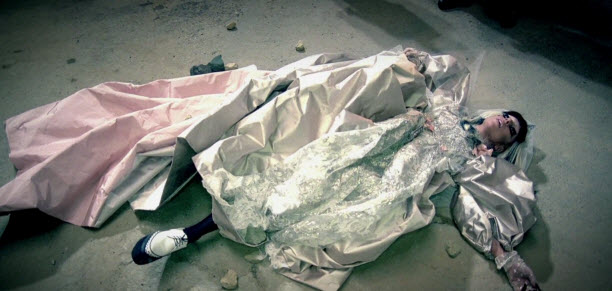
    So Gaga plays the role of Mary Magdalene where Magdalene is not only the friend and disciple of Jesus, but his lover. This portrayal of Mary Magdalene as Jesus’ mate became popular in the past few decades with books such as The Jesus Scroll (1972), Holy Blood, Holy Grail (1982), The Gospel According to Jesus Christ (1991), The Da Vinci Code (2003), The Two Marys: The Hidden History of the Mother and Wife of Jesus (2007); and by films like Bloodline (2008). These alternative accounts on Jesus Christ’s life originate from modern interpretations of Gnostic and apocryphal texts (mainly the Nag Hammadi) where Magdalene is described as Jesus’ “favorite disciple” and “companion”. An interpretation of the apocryphal Gospel of Philip even alludes to Jesus “often kissing Mary Magdalene on the lips”.
    Some occult circles believe that Jesus lived well beyond the age of 33 (a number they believed was selected for symbolic reasons). Some claim that Jesus married Mary Magdalene with whom he had a daughter named Sarah. Some even claimed that they moved to Southern France, where they started the fabled Merovingian Bloodline.
    Judas therefore portrays Mary Magdalene from this angle, where Gaga is the wife of Jesus. However, she only has eyes for Judas.

    Algo de la Edad de Horus aqui:
    http://www.nachtkabarett.com/theOccult/AgeOfHorus
    It is time for their world to be destroyed. It is time for a new age, the Age of Horus. It is time for a new standard, a new canvas, and a new artist. We must forget this wasted generation and amputate it before the mind rots away with it. Paint it, record it, write it down before they kill you with their slow poisonous stupidity. Make yourself heard.
    This Internet is your middle finger to the universe, don't let them break it.
    Fuck their world. Let's make our own.
    The third and final Beast
    Marilyn Manson

    El 'bottom line': Jesus cerro la edad de Piscis y Lucifer abre la Edad de Horus..
    No entiendes?  Es como cuando los abogados mataron el nombre de Walter Mercado para ahora  llamarlo Shanti Ananda...
    http://www.elnuevoherald.com/2012/01/10/1095817/walter-ahora-shanti-ananda-martes.html

    [Churn out]

    Thursday, April 8, 2010

    Sobre el Rapto, la Fe Ciega y el Terrorismo

    He mencionado en otros articulos que este blog trata de dos temas centrales: uno es la conservacion ambiental y la otra mis inquietudes en cuanto a lo que pudiesen llamar esoterismo. Por mis notas saben que soy catolico y tengo mucha fe en las ense/nanzas plasmadas en los libros de la Biblia y la tradicion milenaria de los Padres de la Iglesia, la pega que une la Iglesia y que la mantiene viva tras 2,000 a/nos de existencia.
    Les dejo con una cancion que tengo en mi cabeza hace varios dias (U2-Wake Up Dead Man del CD POP)
    http://www.youtube.com/watch?v=_acPQ7BBQis)

    La letra aqui:
    Jesus, Jesus help me
    I'm alone in this world
    And a fucked up world it is too

    Tell me, tell me the story
    The one about eternity
    And the way it's all gonna be

    Wake up, wake up dead man
    Wake up, wake up dead man

    Jesus, I'm waiting here boss
    I know you're looking out for us
    But maybe your hands aren't free

    Your father, He made the world in seven
    He's in charge of heaven
    Will you put in a word in for me

    Wake up, wake up dead man
    Wake up, wake up dead man

    Listen to your words they'll tell you what to do
    Listen over the rhythm that's confusing you
    Listen to the reed in the saxophone
    Listen over the hum of the radio
    Listen over sounds of blades in rotation
    Listen through the traffic and circulation
    Listen as hope and peace try to rhyme
    Listen over marching bands playing out their time

    Wake up, wake up dead man
    Wake up, wake up dead man

    Jesus, were you just around the corner
    Did You think to try and warn her
    Or are you working on something new

    If there's an order in all of this disorder
    Is it like a tape recorder
    Can we rewind it just once more

    Wake up, wake up dead man
    Wake up, wake up dead man
    Wake up, wake up dead man

    Pero mi fe no es ciega. Es una fe racionalizada. Usando el sentido comun y el norte moral de mi consciencia. No soy el unico que piensa asi, les incluyo un link que presenta la vision de Dios y la ciencia de cientificos brillantes de diversas eras...http://www.feyrazon.org/sabios2.htm
    "Omne verum, a quocumque dicatur, a Spiritu Sancto est"
    Toda verdad, dígala quien la diga, viene del Espíritu Santo
    (Santo Tomás de Aquino)
    Tema # 1 - Terrorismo de Ultra Derecha
    Jesus predico la ley del amor, la tolerancia a los demas y la igualdad. Pero como he dicho en varios comentarios sobre la pedofilia en la iglesia catolica, el problema de la fiebre no esta en la sabana. Los principios cristicos son correctos, los principios morales tambien. La falla radica en los hombres y el poder.
    Cualquier fe ciega. Hasta se puede ser ciego sin tener ninguna fe. Aunque no creas en Dios, o su facsimil razonable. Todo en exceso es malo, sin excepciones. Personalmente me preocupa esta ola de homofobia que toma auge entre fundamentalistas americanos, lo ciegos que estan los teabaggers republicanos en un asunto de salud o en llegar al extremo de matar a alguien que se quiere hacer un aborto (que hasta donde tengo entendido sigue siendo legal).
    Se puede diferir de la agenda homosexual o de otros libertinajes sin apedrear, insultar o matar. Pero esa leccion del amado Jesus quedo en el olvido. Es mas facil tirar la piedra... Para muestra dos botones listados debajo:

    Tema # 2 - The Rapture (1991)


    Sobre ese tema de los derechos, la moral y el 'yo soy mas santo que tu porque creo en la iglesia xxxx' trata la pelicula The Rapture -1991 con Mimi Rogers. Personalmente la pelicula me impacto un monton pues trata de la evolucion de una teleoperadora swinger a evangelica fundamentalista, a fiel creyente del rapto, a matar a su hija por el rapto y finalmente renegar de un Dios cruel y autoservicial. Existira esta pelicula en algun video? Me imagino que estara escondido en el fondo de la pila de dramas con 5 copias de titanic encima...
    Por si acaso les incluyo notas de la pelicula aqui y dos escenas impactantes:
    ebert's review
    http://rogerebert.suntimes.com/apps/pbcs.dll/article?AID=/19911027/REVIEWS/110270301/1023
    The Rapture BY ROGER EBERT / October 27, 1991

    In one way or another, I have been waiting for the apocalypse all of my life.
    Most people, I imagine, never think about it, and those who do probably fear it.
    Not me. I expect to be filled with joy during the final battle between good and
    evil, while those fearsome horsemen thunder through the sky - because at least
    then I'll know for sure that something exists beyond the material universe, and
    therefore it is possible to escape from death.These days, I no longer really
    think of the end of the world in literal terms. I envy the faith of those who
    do. When I was in parochial school, the notion of Judgment Day filled me with a
    rush of danger, as I imagined the Lord evaluating billions of lifetimes, and
    then turning a particularly stern eye on a certain fifth-grader from Urbana,
    Illinois.There have been dozens of movies that dealt in one way or another with
    the afterlife, with death and heaven and hell. But not until
    Michael
    Tolkin
    's "The Rapture" has there been a movie to seriously consider what the end of the
    world might be like, if the biblical prophecies turn out to be literally true.
    Here is one of the most radical, infuriating, engrossing, challenging movies
    I've ever seen. There are people who love it and many who hate it, but few who
    can remain on the sidelines. It's a film with the same ambiguity of the
    Thomas-Hill hearings; everyone sees the same thing, but nobody can agree on what
    it means. ("
    The Rapture" is set to open Nov. 8 at the Water Tower.) Walking into the movie
    for the first time, last Labor Day at the Telluride Film Festival, I hardly knew
    what to expect. Certainly not a film that began with casual sex, and ended with
    a literal depiction of a fundamentalist view of the apocalypse. All I knew of
    Michael
    Tolkin
    , who wrote and directed "The Rapture," was that he was also the author of The Player, a cold, brilliant novel about a Hollywood studio executive who commits a murder more or less by
    accident, and then deals with the guilt in passages of excruciating paranoia.What did we have here? "
    The Rapture" opens with Mimi Rogers playing Sharon, a woman who works as a phone information operator.One of dozens of anonymous voices, parceled out in cubicles in a vast room, she conducts impersonal conversations with strangers. In the evenings, accompanied
    by her lover (
    Patrick Bauchau), she cruises cocktail lounges, looking for other couples who want
    to "swing." They trade mates for sex that is quick, passionate and impersonal.One day, she overhears co-workers whispering about their dreams. She has had the same disturbing dream, of a pearl suspended in a void. She is drawn into a circle of these people, who have gathered around a young black boy who has the gift of prophecy, and informs them that the world is coming to an end.
    One night, filled with despair, Sharon calls out in anguish to God, and is born again.And then the film grows harsh and uncompromising, as she marries, has a daughter, and eventually finds herself standing under the barren desert skies with the child, waiting for the second coming of Jesus.Everything she does is consistent with the fundamentalist view of how the world will end. There is even an argument for the shocking act she commits, several weeks into her vigil,
    although of course it is wrong - inspired by the sin of pride, of thinking she knows God's plans. Watching the film, I wondered how far Tolkin would go. Would the movie lose courage, and end in some kind of sentimental compromise? Or would it go for the literal depiction of the end? Tolkin goes for it. I must be careful not to reveal too much, but let me say that when the bars began to drop from the doors of the jail cells, and fell with a clank to the stone floors, I
    remembered the nuns describing that final day, when the dead would rise up from the graves, and the prisoners be freed from their cells, all to face a judgment higher than man's.If this movie doesn't leave this earth, I thought to myself, and take me to whatever is on the other shore, I will be angry and disappointed.
    Can Tolkin be leading me on? He has gone too far to lose heart now.But Tolkin does not lose heart. And the closing scenes of the movie show Sharon leaving this earth and standing on a shore between Purgatory and Heaven. There, she defies God by asserting something we have all thought from time to time: That he has made us his playthings,that he has asked too much of his creatures. That being free to create any universe, he has made one that stands much in need of
    improvement.It has been accurately observed that Tolkin's special effects in the closing sequences leave something to be desired. True,
    George Lucas or Ridley Scott could have done more with the River Styx, given several million dollars. But the budget necessary for those special effects would have compromised the film - no one would have risked that kind of money on a movie this daring. Besides, it isn't how the effects look that's really important,
    it's what they say.And in "
    The Rapture," Tolkin takes Sharon on a terrible journey, from sin through redemption to the ultimate meaning of the rules made by God.The term "religious
    film" usually summons up pious banalities, spoken by characters who have not had a thought in their lives. Most movies about the afterlife use the idea of heaven as a plot gimmick, in stories about moony-eyed lovers who find each other because of a mistake in the celestial bookkeeping.But the next world is not likely to be fuzzy and warm. We live in a terrifying universe, and Christian theology, read literally, makes it more terrifying still: After our allotted
    decades on earth, during which we pass the time by eating, drinking, smoking, having sex, working, watching TV, going on vacations, becoming sports fans and taking up hobbies, we are suddenly catapulted into a realm where we will spend eternity in either infinite bliss, or infinite misery.If we lived in full belief and full consciousness of such an eternity, surely life would drive us mad. The risk of damnation would be too great to allow a moment's relaxation, and indeed
    some of the saints seem to have been deranged by such fears, their insanity passing for holiness. The great courageous act of Tolkin's "The Rapture" is to consider such questions in a film that is not overtly "religious" at all. He is not trying to proselytize or convert his viewers, and indeed I imagine some believers will be quite offended by this film. What he is doing, from a secular
    point of view, is examining the logic of the final judgment as radically and uncompromisingly as he can.Movies are often so timid. They try so little, and are content with small achievements. "
    The Rapture" is an imperfect and sometimes enraging film, but it challenges us
    with the biggest idea it can think of, the notion that our individual human
    lives do have actual meaning on the plane of the infinite.


    Cuando decide enviar a su hija al Se/nor porque el rapto tarda demasiado... (ouch!)
    http://www.youtube.com/watch?v=uqFFNAeGEXg
    Entonces ocurre el rapto. Y Sharon decide amargamente no seguir a un Dios tan cruel. Se queda en soledad.
    http://www.youtube.com/watch?v=DASZbfVnoy0

    Tema # 3 - Curso En Linea de Sistemas Folcloricos de Ayuda (Prof. Nu/nez-UPRM)
    Una lectura intersante.
    http://www.uprm.edu/socialsciences/sfaenlinea/id15.htm
    Encontre interesante sobre todo la discusion en espiritismo kardeciano, Lumen y Casa de Las Almas...http://www.uprm.edu/socialsciences/sfaenlinea/id56.htm
    Interesante. Encontre este curso buscando una disertacion sobre fe racional.
    Como dice el logo 'a Dios por la Ciencia'
    Tema #4 - Collateral Murder Video
    Ya todo esta dicho. La discusion del tema en los links debajo. Mi opinion es que en general la guerra deshumaniza. Si no deshumanizas a tu enemigo, viendolo como algo inferior no halarias el gatillo. Eso es el entrenamiento militar, eliminar o atontar ese safety lock moral del no mataras. Extrapolar esto a que si son americanos, son iraquies, son taliban y decir que lo mataron por desprecio...No lo creo. Por una sencilla razon: Pues si, eso es la guerra. Lo que pasa es que ahora la podemos ver en vivo y en high definition.
    O acaso los que firmaron las fuerzas armadas pensaron que solo era por el pase por el PX, a comprar cerveza barata en Buchanan o Roosevelt Roads? Esperate ahi...Vamos a pararlo.
    Eso no fue justo. Ese tema es complicado porque muchas veces es la unica solucion para salir del hoyo. Y eso es otra historia.


    Cierro esta nota resumiendo la fe cristiana segun visto por Coldplay en Viva la Vida
    Viva La Vida /Coldplay
    I used to rule the world
    Seas would rise when I gave the word
    Now in the morning I sleep alone
    Sweep the streets I used to own
    I used to roll the dice
    Feel the fear in my enemy's eyes
    Listen as the crowd would sing:
    "Now the old king is dead!
    Long live the king!"
    One minute I held the key
    Next the walls were closed on me
    And I discovered that my castles stand
    Upon pillars of salt, and pillars of sand
    I hear Jerusalem bells are ringing
    Roman Catholic choirs are singing
    Be my mirror my sword and shield
    My missionaries in a foreign field
    For some reason I can't explain
    Once you go there was never, never an honest word
    That was when I ruled the world
    It was the wicked and wild wind
    Blew down the doors to let me in.
    Shattered windows and the sound of drums
    People couldn't believe what I'd become
    Revolutionaries Wait
    For my head on a silver plate
    Just a puppet on a lonely string
    Oh who would ever want to be king?
    I hear Jerusalem bells are ringing
    Roman Catholic choirs are singing
    Be my mirror my sword and shield
    My missionaries in a foreign field
    For some reason I can't explain
    I know Saint Peter won't call my name
    Never an honest word
    But that was when I ruled the world
    (Ooooh Oooh Oooh)
    Hear Jerusalem bells are ringing
    Roman Catholic choirs are singing
    Be my mirror my sword and shield
    My missionaries in a foreign field
    For some reason I can't explain
    I know Saint Peter will call my name
    Never an honest word
    But that was when I ruled the world
    Tags en Blogalaxia
    Related Posts Plugin for WordPress, Blogger...