http://www.camaraderepresentantes.org/noticiasread4.asp?r=%7B4E7AC583-3050-431E-9FF4-3E54B1A30411%7D
http://www.wapa.tv/print-version.php?nid=20110325164138&other=/noticias/salud/ojo-a-los-medicamentos-falsificados/20110325164138
La practica de falsificar drogas existe y es un mercado negro a nivel mundial. Si buscas una medicina barata (aunque no la apruebe la FDA) o lo compras en un flea market o tienda de suplementos naturales deberias saber que posiblemente no tenga la potencia o dosis correctas. Esto es sentido comun. Es mas, es lo que promueve la FDA (http://www.fda.gov/ForConsumers/ConsumerUpdates/ucm048380.htm)
Donde se dificulta es cuando se compra el medicamento en linea o en el mercado negro, donde el inescrupuloso (a alto nivel) vende su producto adulterado. Se supone entonces que tenemos salvaguardas. El principal, a nivel de Puerto Rico, es que tenemos a la FDA, que regula las farmaceuticas y toda formulacion o producto farmacceutico. Si eso no bastara los medicamentos son distribuidos y aprobados por un farmaceutico, debidamente licenciado y que tiene una licencia que perder si te vende un producto adulterado. Ademas, se despacha mediante recetas. Donde se debe prestar atencion es en auditar apropiadamente a los centros de distribucion como Drogueria Central, solo por decir uno. O sea, si compras tus medicinas en una Farmacia de la Comunidad, Farmacias Plaza, Walgreens o CVS posiblemente no tengas problemas.
Eso fue lo que debio haber argumentado el Colegio de Farmaceuticos y las grandes cadenas de farmacias. Sin embargo, prefirieron vender el miedo. Haciendo legislacion para perseguir los suplementos naturales y crear miedo a los genericos y bioequivalentes. La guerra, realmente, es a los distribuidores de productos y suplementos naturales denominados 'Potencia Sexual", igual al Viagra, etc. Me imagino que Carbotrap y el Te Chino del Doctor Ming estaran en su mirilla.

El Miedo a lo Distinto
Si lee las recomendaciones de los sites de salud te dan el siguiente mensaje generico:
Ejemplos debajo:
http://www.fraud.org/fakedrugs/faq.htm
How can I tell if my drugs are counterfeit?
The best way for consumers to identify potential counterfeits is to be as familiar as possible with the drugs they regularly take. It’s difficult to tell just by looking at them, but the more familiar you are with both the packaging and the drugs themselves, the better the chances are that you’ll detect a fake drug before taking it. If you know the size shape, color, and taste of the medications you take, you will more easily identify possible counterfeits. When something doesn’t look or taste quite right, be suspicious. Check for altered or unsealed containers, or changes in the packaging or label. You might also be able to tell if a drug doesn’t have the effect that it promises, has different side effects than described, or doesn’t work in the same way as it did when you took it previously. You can reduce the risk of getting counterfeit drugs by buying from reputable pharmacies, but even they sometimes offer counterfeit drugs for sale without realizing it.
Un medicamento generico usualmente tiene forma distinta y sabor distinto al medicamento de marca. Sin embargo, su forma y color son correctos si fueron aprobados por la FDA.
Mea Culpa de Farmaceuticas Locales
Farmaceuticas de renombre como Schering, SB Glaxo y McNeil tuvieron sus dias de suerte cuando la calidad de sus productos de marca fue cuestionado por la FDA. Grandes ordenes administrativas les fueron puestas y estan bajo gran escrutinio federal. Pudiesemos hasta estar hablando de que habian redes de mercado negro donde se sospecha pudieron haber infiltrado productos 'off spec' a un publico incauto.
Esa regalmentacion contra corrupcion es cada vez mas fuerte. En cualquier charla de seguridad de una farmaceutica o entrevista de empleo se vera que haber sido implicado en uno de esos casos te pone una mancha negra en el expediente donde tu unica oportunidad de volver a trabajar en un ambiente de higiene es en un McD o BK. Repasando algunos de estos casos debajo:
esta fue de SB Glaxo:
http://www.psychologytoday.com/blog/side-effects/201101/bad-medicine-glaxosmithklines-fraud-and-gross-negligence
That last claim would be more persuasive if we didn't learn from the 60 Minutes report that the 900 people working at the plant made "20 drugs for patients in the U.S.," among them such blockbusters as Avandia for diabetes, Paxil antidepressants, Tagamet antacids, and the anti-bacterial ointment Bactroban. Or that "it was an FDA inspection that first revealed problems at Cidra... That's why Glaxo sent Eckard's team in to resolve those FDA concerns." It had to, in short.
Cheryl Eckard asserts that she discovered far worse infractions and contaminations of the drugs than even the FDA investigators, and that, despite repeatedly alerting her colleagues at GSK to these problems--colleagues who had trusted her judgment enough to make her a manager of global quality assurance, after ten years' work for Glaxo in quality control--senior management at the corporation both ignored her documented concerns, then lied to federal investigators about them, saying it was "extremely unlikely" that its plant had sent out batches of Paxil containing two different doses, despite pharmacists calling the plant directly when patients showed up with different colored pills in their medicine (signaling different doses of the antidepressant). The opening of sealed packets of Paxil revealed the same problem. One of the people affected was an 8 year-old boy whose prescription included adult doses of the powerful anticholinergic antidepressant.
According to 60 Minutes, Eckard nevertheless produced a chart for company executives documenting "the kinds of mix-ups that were happening at Cidra. She identified nine, including Avandia diabetes pills mixed in packages with over-the-counter Tagamet antacids and Paxil antidepressants, mixed with the Avandia diabetes drug." According to Eckard, she went to the FDA--and taped the conversation as proof, given GSK's repeated disputes of her findings--after those and many other infractions were ignored.
In pleading guilty to the felony, Glaxo admitted that it distributed "adulterated drugs Paxil CR, Avandamet (a diabetes drug), Kytril (a drug given to cancer patients), and Bactroban," which strongly suggests that Eckard was telling an inconvenient truth all along.
Among the lessons we can take from this case is, first and foremost, how readily and extensively a vast corporation such as GSK will mask, dispute, or spin the truth, when it suits the corporation, to avoid addressing even glaring safety concerns. This is perhaps the most shocking part of the scandal at Cidra. Not only can we not trust a drug giant like GSK to avoid distributing defective medication, contaminated by bacteria and adulterated in dose, but we also discover just how far such corporations will go to ensure that we never learn the full extent of such problems in the first place.
Y espera, que Schering tambien fabrica la medicina amarga. Tendra que ver con la que distribuyo Fortu/no con la Ley 7?
http://lubbockonline.com/stories/051802/bus_0518020006.shtml
http://money.cnn.com/magazines/fortune/fortune_archive/2002/10/14/330051/index.htm
Schering, of course, isn't alone in skirmishing with the FDA. The agency--despite its lack of a leader at the helm (see "The Big Gap at the FDA" on fortune.com)--is becoming more rigorous about drug industry oversight. In the past two years Abbott Laboratories, Eli Lilly, Johnson & Johnson, Pfizer, and Pharmacia have all come under fire for production violations. None of those companies, however, rival Schering-Plough in the severity or protracted nature of their violations.
The FDA's regulations are admittedly strict. Under its "current good manufacturing practice" guidelines, every aspect of production--from handling procedures and laboratory conditions to the ingredients in the products--must be tested and retested continually. If, for example, a company changes a single piece of equipment in its production line, plant managers are required to generate several studies of the entire production line to guarantee uniformity of the end product. The rules change from time to time. "If one company comes up with a new way to ensure quality, that quickly becomes the standard for the industry," says William Vodra, a former FDA lawyer who wrote the current regulations in the late 1970s. All these quality controls, of course, are meant to ensure that the drugs that reach consumers' medicine cabinets are safe and effective. And though they have their faults, the regulations aren't difficult for the majority of drug companies to adhere to.
Oh no, Bristol Myers Squibb Manati tambien!!! Is there no God!!!
Regulators said the New York drugmaker’s plant in Manatí has not established or followed rules to prevent contamination of drugs. The observation followed an inspection in March, and federal officials found similar cleanliness problems in 2005 and 2009.Regulators also said the company has failed to investigate subpar manufacturing practices and standards, and that there have been ongoing problems with employees complying with procedures implemented due to these recurrent violations.
The agency also faulted Bristol for not thoroughly investigating the failure of a batch or its components.
The FDA warning did not specify which drugs were involved or whether the violations involved distributed products. The letter did cite injectable lyophilized products, which are packaged in glass vials.

A pesar de su alto precio y una calidad que ha decaido en los ultimos a/nos, segun las auditorias de FDA, basado en la discusion anterior, ahora tienen la competencia de las genericas. Que cada dia crecen, segun las patentes expiran. Eso redunda en un menor precio para el consumidor (y para los planes de salud pero eso es harina de otro costal). Las grandes cadenas le temen a estos peque/nos manufactureros, que pueden fabricar su caro producto, basado en a/nos de research and development y de mucho refinamiento, pero ahora a una fraccion del costo y mucho mas eficiente. Plantas como INYX, TEVA y otras pueden cambiar sus recetas ante la FDA como si fuese escoger entre vainilla, chocolate o rocky road.
Miren un ejemplo con TEVA:
http://www.biojobblog.com/2010/03/articles/biobusiness/the-bidding-war-is-over-teva-to-acquire-ratiopharm/
Teva Pharmaceutical Industries Ltd announced today that it has entered into a definitive agreement to acquire Ratiopharm, Germany's second largest generics producer (Novartis AG’s Hexal unit is first and Stada Arzneimittel AG is third) and the sixth largest generic drug company worldwide, for €3.625 billion ($ 5.0 billion). Teva expects to complete the transaction by year-end 2010.
The acquisition will position Teva as the leading generic pharmaceutical company in Europe. Ratiopharm's extensive product portfolio includes 500 molecules in over 10,000 presentation forms covering all major therapeutic areas marketed in 26 countries. Also, Ratiopharm has valuable know-how in biosimilars (a market that Teva has entered and is extremely bullish on) which consists number of products in advanced stages of development and a well-established sales and marketing team. The combined company will have 40,000 employees worldwide, of which 18,000 will be based in Europe. The purchase will bolster Teva’s visibility and standing in European markets.
Late last month, Ratiopharm board members implored Pfizer to enter a new bid, after it had rejected an earlier offer by the company. Apparently, the new bid was not sufficient to prevent Teva from acquiring the highly sought after generics manufacturer. Iceland-based generics manufacturer Actavis also put in a failed bid to acquire Ratiopharm.
Los Brand Names como Abbott y Pfizer estan en Guerra con Generic Lands
http://www.gibbonslaw.com/files/1172848563.pdf
Brand drug manufacturers whose patent law monopolies expire will continue to
develop competitive strategies to preserve market share in the face of new competition.
Those strategies may predictably rely on the non-price dimensions of competition
over which the brand manufacturers enjoy an advantage. State DPS laws may well
refl ect a legislative desire to give primacy to the price dimension of competition by
relieving generic manufacturers of the usual costs and burdens of non-price competition
in the areas of name recognition, brand loyalty and marketing prowess. A brand
manufacturer that deliberately avoids triggering those DPS laws may be impairing
that legislative policy choice. Such a strategy, however, cannot necessarily be termed
anticompetitive, if the strategy is properly understood to force competition across all
competitive dimensions, including non-price factors. This is not to say that particular
implementations of the reformulation strategy may not run afoul of the antitrust
laws. Rather, courts should be careful to determine whether the conduct in question
actually forecloses entry of a competitive product, or merely avoids triggering legislation
that gives the new entrant an advantage it would not otherwise enjoy. If entry is
not foreclosed, then judicial second-guessing of the manufacturer’s design-choices
is ill-advised for the reasons expressed in Berkey Photo. Under those circumstances,
the more deferential test for antitrust illegality announced in Berkey Photo is more
appropriate. If the ability to avoid triggering DPS laws is undesirable from a regulatory
policy perspective, that problem should be left to FDA and state legislatures to
fi x, not addressed by a misapplication of the antitrust laws.
Un Ejemplo: Bloquear Las Cadenas de Distribucion
http://online.wsj.com/article/SB10001424052748703808904574529690806933018.html
WASHINGTON—The Federal Trade Commission expressed concern about the practices of brand-name drug makers after generic drug companies complained they can't get bulk supplies of some medicines they want to copy.
GlaxoSmithKline PLC and Celgene Corp. are among the brand-name makers citing a federal drug-safety program in declining at this point to supply bulk quantities of certain drugs. They say the generic companies aren't authorized to buy drugs under the program. The generic companies say that's an excuse to block competition.
The situation has gotten the attention of the FTC, which investigates anticompetitive behavior in consumer markets. "We're going to be very concerned about any practice that could increase prescription-drug costs to American consumers," FTC Chairman Jon Leibowitz said in an interview. "You can't let drug safety be used as a tool to delay generic competition."Asi que tenga usted cuidado. Que Amiplin no es una droga registrada (por mi mai, miralo aqui)
http://www.drugs.com/international/amiplin.html
No se si la jodeina sea ilegal. Parece que nadie la mercadea.
Fake and Counterfit Drugs
El punto es. Existe un mercado de drogas falsas e ilegales. Mi esposa me llamo la atencion a este documental de National Geographic y PBS sobre el tema: Illicit. Info debajo:
http://www.nationalgeographic.com/illicittrade/
Join undercover agents and slip into the shadowy web of illicit trade, where dangerous multi-billion dollar criminal networks threaten whole sectors of the world economy. Illicit: The Dark Trade travels the globe to expose the dire consequences of this dirty industry: money laundering, political corruption, and the subversion of entire governments. From knock-off handbags to bootlegged compact discs to fake pharmaceuticals, this hard-hitting special reveals how consumers' insatiable demand for counterfeit merchandise has given birth to a vast criminal system.
Based on the bestselling book "Illicit" by Dr. Moises Naim, acclaimed editor of Foreign Policy magazine.
http://www.pbs.org/programs/illicit/
http://www.pbs.org/newshour/rundown/2010/06/fake-drugs-a-global-health-threat.html#
http://www.theepochtimes.com/n2/business/pharmaceutical-industry-battling-counterfeit-drugs-52385.html
http://www.america.gov/st/washfile-english/2006/December/20061201120711LNkaiS0.2569086.html
Simplemente expongo que estos temas no son simples. Requieren analisis y tienen otras cosas detras. Los Farmaceuticos y Farmacias estan detras de los que venden suplementos naturales. Si los homeopaticos y suplementos naturales funcionan o no es irrelevante en esta discusion. Solo digo que el esfuerzo deberia ir enfocado en caerle arriba a los programas de auditoria a sistemas de salud publica y sistemas de suplidores de Medicare para que no le pasen gato por liebre para poder completar el pago del yate de este mes.
Esta legislacion, como siempre, les terminara mordiendo el rabo.
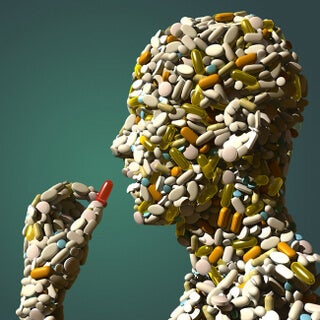
Head of Pills above: http://singularityhub.com/wp-content/uploads/2010/12/head-of-pills.jpg
fukitol: https://blogger.googleusercontent.com/img/b/R29vZ2xl/AVvXsEhADX3JGkuJ9ZzAvBycmR-ZORpZkpzc_B4PItHicekdcsMQBkeaXbB13121n23OkRqDVO7UR0XPYB1tcfyIEAnZHrYlLcxPseyyXwk4EDroGuN6Vtrq0YWIpJvngI9P0aW08l76Gs7Mqm_8/s1600/fukit.jpg
[End of Line]